How Much Will It Cost? (The Instant Answer)
It's the most consequential question any prospect asks. Here's how to give a useful answer on the spot.


During an initial consult with a new client–or when discussing a large feature request with an existing client–one question inevitably comes up:
How much will this cost?
My typical response is something along the lines of, "It's impossible to give you a realistic number without doing some (paid) discovery work first."
That's an unsatisfying answer, so it's nearly always followed up with this question:
It doesn't have to be exact; just give me a ballpark number.
I used to respond to that with something flippant, like "More than $500 but less than $5 million." Always delivered with a smile and usually immediately followed up with, "Seriously, though, it's impossible to give you an accurate estimate without fully understanding the scope of the problem and designing the solution." At that point, I would then provide an estimate for the paid discovery work.
But here's the thing: clients and prospects are (somehow) even worse than developers at estimating project scope. They are often orders of magnitude off from what something will cost to build as a custom piece of software.
Fellow Access MVP Armen Stein wrote about this phenomenon in his article, Off by a Zero:
 Armen Stein
"An x-Figure Project"
I took Armen's concept and turned it into an instant answer to the question, "How much will this cost (in ballpark terms)?"
"This is about a #-figure project."
To use it, simply substitute a number for "#" appropriate to the project's size:
"This is about a ..."
- 3-figure project: [$100-$999] a small feature request for an existing client
- 4-figure project: [$1,000-$9,999] a small project for an existing client
- 5-figure project: [$10,000-$99,999] a typical project for a new or existing client
- 6-figure project: [$100,000-$999,999] a major, months-long project
- 7-figure project: [$1,000,000-$9,999,999] a massive, years-long project
Honestly, most projects fall right in the 5-figure project range.
If I think it's on the borderline of one number or the other, I might throw a "low" or "high" qualifier before the number. For example:
- "This would be a high five-figure project." or
- "This would be a low six-figure project."
Go / No-Go on Paid Discovery Work
At this point in the conversation, the main value of answering, "How much will it cost?" is that it lets the client decide whether the magnitude of the cost roughly matches the magnitude of the benefit:
 Mike Wolfe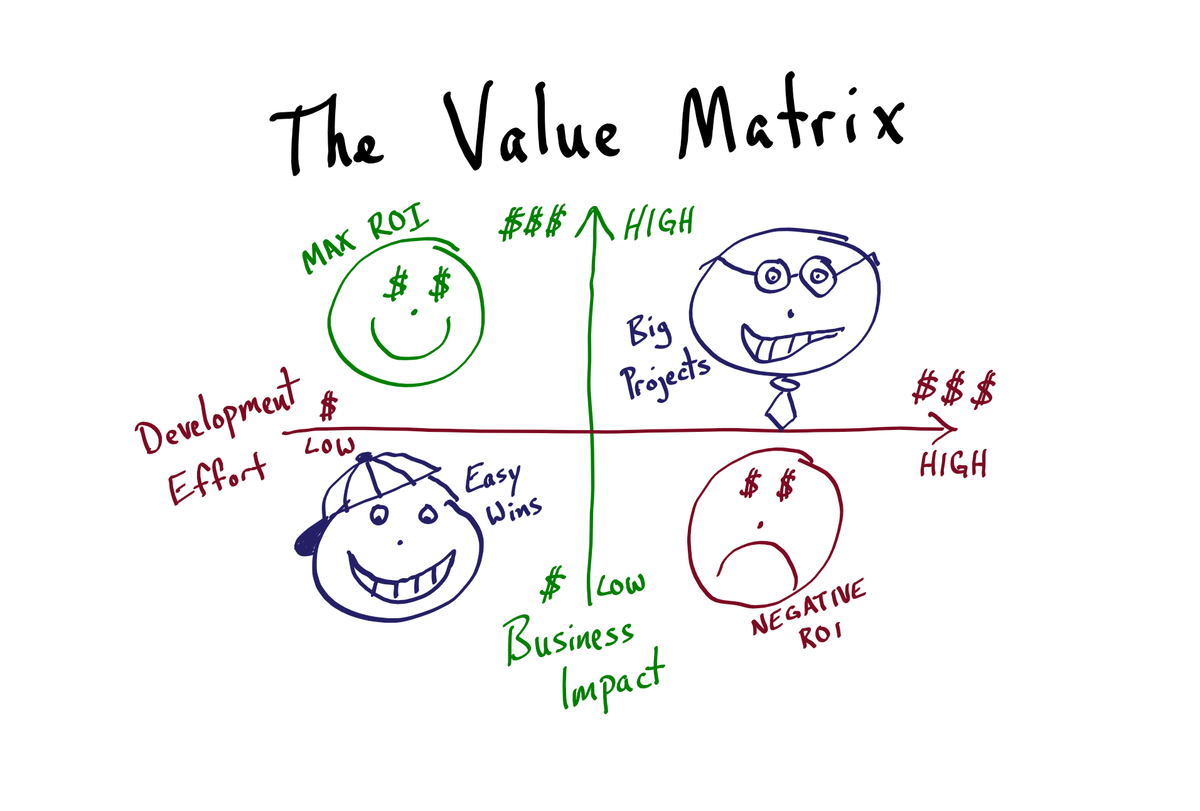
Scope Redesign Opportunity
It also provides an opportunity for immediate scope redesign.
If I say, "Sure, we can build you what is essentially your own custom version of QuickBooks. That will be a low 7-figure project."
The client may say, "Whoa, it's not worth that much to us!"
At which point, we can start exploring alternative solutions with less scope, for example:
- A set of custom Excel workbooks that pull down QuickBooks data via their web API.
- A set of Zapier automations to reduce your most time-consuming QuickBooks workflows.
- Etc.

