The Value Matrix: Prioritizing Work for New Clients
From Home Runs to Money Pits, this handy reference will help keep you focused on delivering value to your clients as a Microsoft Access consultant.

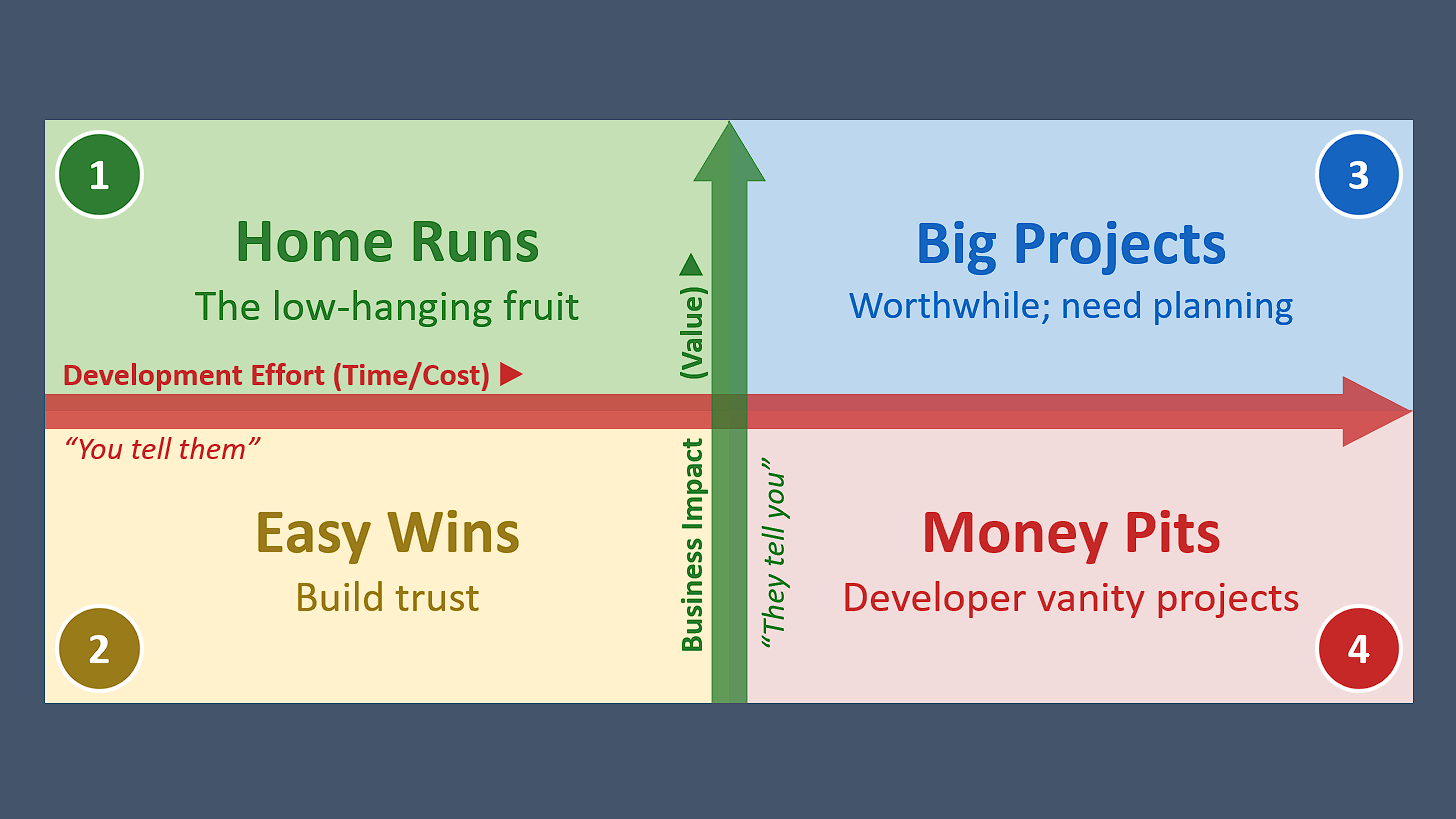
My company specializes in taking over support for complex, business-critical Access applications:
 Mike Wolfe
When we begin an engagement, we often start by going through the client's backlog of bugs and feature requests.
Effort vs. Impact
For each item, we determine two values:
- Development Effort: how much time will it take us to resolve the item?
- Business Impact: how much value would resolving the item bring the client?
We, the developers, answer the first one.
The client answers the second.
Effort Levels
We don't stress over precise estimates in the first meeting. We think in magnitudes:
- Minutes
- Hours
- Days
- Weeks
- Months
- Years (!)
Impact Levels
Similarly, we ask our clients to choose a priority from a simple scale:
- Low
- Medium
- High
- Urgent
Planning vs. Budgeting
Keep in mind, the goal for this first meeting is high-level planning–not detailed budgeting. At this stage of the engagement, we just need to figure out a rough roadmap of next steps.
The above categories are intentionally simple. They allow both sides to make an instant assessment during a live meeting. The data can then be captured in the metadata of a new Linear issue that we create in real time during the meeting.
At the end of the exercise, we have enough information to plot the issues on our matrix and decide next steps together.
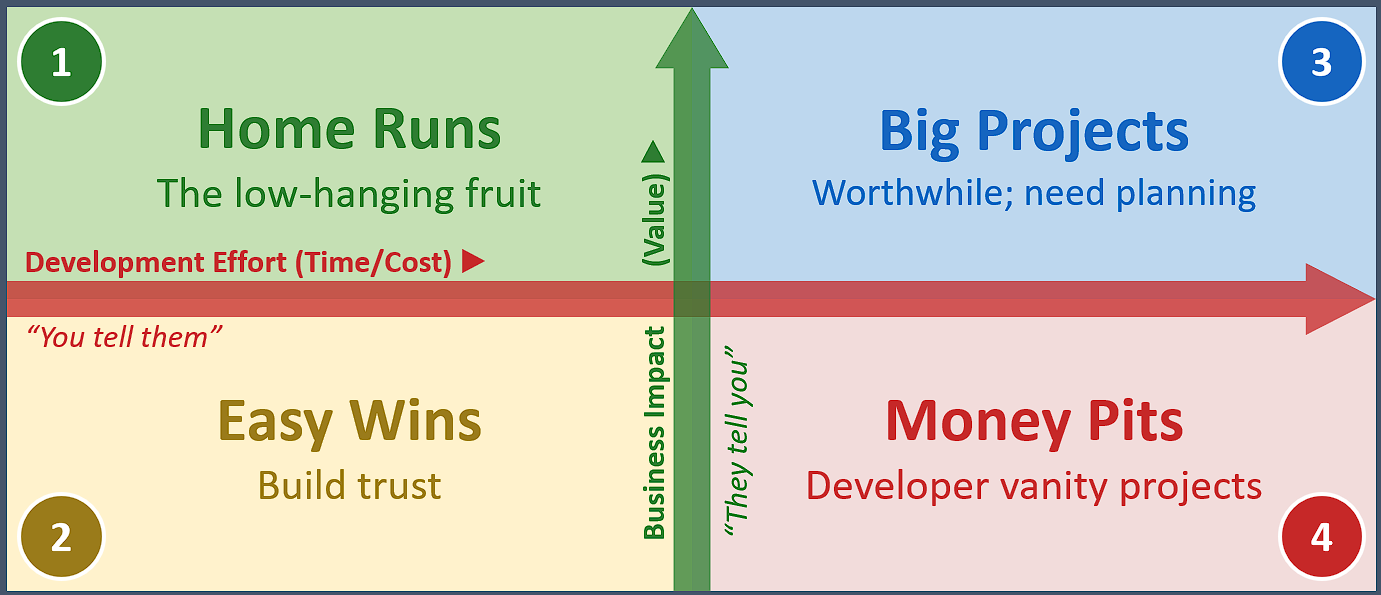
Sequencing the Work
1. Home Runs
This is the low-hanging fruit. Low development effort from us and high business value impact for the client. These are no-brainers. Obviously, we start with this quadrant.
2. Easy Wins
At first glance, LOW effort/LOW value items (lower-left quadrant) and HIGH effort/HIGH value items (upper-right quadrant) seem like they would be a toss-up for which projects go next.
We need a tie-breaker.
The tie-breaker is related to neither cost nor value: it's about the client relationship.
Banking a few quick wins is a great way to build trust with a new client.
3. Big Projects
Once we've built up credibility with the client, we are on more solid ground to take on bigger projects.
The credibility buildup is key to making this quadrant work.
When done right, most "big" projects are front-loaded with behind-the-scenes work (database schema changes, refactored security, etc.). If you haven't built up credibility yet, your client may lose patience long before the feature ever lands.
4. Money Pits
These are the Siren songs of every developer:
- A unique technical challenge they've never seen before
- An opportunity to test out some new code or framework
- Performing a system-wide "code quality improvement" (such as adding missing Option Explicit statements everywhere)
It's easy to focus so hard on the white rabbit that we don't even realize how far down its hole we've followed it.
I call these "Developer vanity projects" because they are inherently me-focused rather than client-focused.
In the business world, no one cares how clever you are. They just want results:
*All text in this article written by a 100%-certified free-range human.

